



Short answer: A live trainer on Microsoft Teams and an AI app like ELAM Coach do different jobs. The trainer prepares you for real conversations, tone and workplace culture. The AI coach gives you extra practice on your own schedule. For most professionals, the best results come from using both on the same learning plan, such as ELAM’s Learner Profiles.
If you’re learning English or French for work, you’ve probably wondered whether an app could do the job. AI language tools have improved quickly: they answer instantly, never tire of your questions and cost far less than a private course. Yet many organizations still book live trainers for their teams.
The two do different jobs. A trainer prepares you to speak with real people in real situations, and an AI coach gives you the extra practice time that makes those situations easier. At ELAM, where we train about 4,000 professionals a year, we use both, and we built ELAM Coach on the same Learner Profiles our trainers teach from.
What does a live trainer on Teams give you?
 In a Teams session, your trainer interrupts, asks a follow-up you didn’t see coming, or waits in silence until you find the words. Meetings with your manager or a client work the same way, and that unpredictability is the hardest thing to rehearse on your own.
A good trainer also notices what you avoid. They hear when you steer around the past tense, when you switch back to your first language under pressure, or when your answer is grammatically correct but sounds abrupt to a colleague. Once a trainer spots a habit like that, the next lesson is built around it.
At the C1 level, our Learner Profiles cover humour and cultural subtleties, such as knowing that “skinny” can sound negative where “slim” doesn’t. That kind of judgment depends on who you’re talking to, and it’s easiest to learn from someone who can tell you how your words landed.
Your trainer also works with your actual job. Bring the presentation you’re giving Thursday, the performance review you’re dreading, or the supplier call you need to prepare, and the session is built around it. Beyond the core profiles, ELAM trainers have access to a growing library of extra competencies and activities, so they can go further wherever you need it.
Finally, a booked session with someone who expects you is a strong reason to show up. When work gets busy, that appointment is often what keeps your progress going.
What do AI language apps do well, and where do they fall short?
AI is very good at volume. It’s available at 6 a.m. before your commute or at 11 p.m. after the kids are asleep. It will repeat the same drill twenty times without a sigh, and it gives you a place to make mistakes privately. For many professionals, the fear of sounding foolish in front of colleagues is the real obstacle, and practicing with a machine first lowers that fear.
The weakness of most AI apps is what they practice. Popular consumer apps follow a general curriculum written for travelers and casual learners. They don’t know that you’re an intermediate learner who has to lead a project meeting next month, so the vocabulary and situations rarely match your work. Practice that isn’t tied to your goals is easy to drop, and progress inside the app doesn’t always show up on the job.
How does ELAM Coach use the Learner Profiles?
ELAM Coach was designed to fix that gap. It uses the ELAM Learner Profiles, the competency-based framework our trainers already follow, so your practice between sessions matches what you’re working on in class.
The Learner Profiles cover six levels, from A0 (Beginner) to C1 (Advanced). Each level is a set of workplace situations, and each situation has clear objectives, the grammar it requires and example sentences:
Level | Sample workplace situations |
A0 Beginner | Greetings, introducing yourself and a co-worker, following instructions in a virtual meeting |
A1 Elementary | Small talk, business trips, presenting your job |
A2 Pre-Intermediate | Interviews, meetings, negotiations, product launches |
B1 Intermediate | Presentations, debates, explaining results, business projects |
B2 Upper-Intermediate | Networking, reports, workshops, performance evaluations |
C1 Advanced | Complex arguments, giving advice diplomatically, humour and cultural nuance |
Because ELAM Coach and your trainer work from the same profile, the two reinforce each other. If your trainer introduced “explaining results” on Monday, your practice that week targets the same objective and the same structures, such as because, due to and resulted in.
The shared framework helps beyond the classroom too. You, your trainer and your HR team can describe progress in the same terms: which competencies you’ve mastered at your level and which ones come next.
How do a live trainer and ELAM Coach work together?
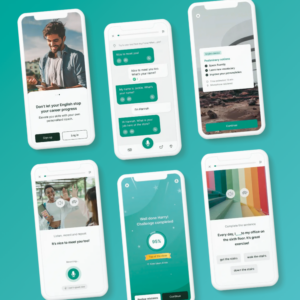 Take a B1 learner who needs to present quarterly results to their team.
- Monday, live on Teams: the trainer introduces the language for explaining results and has the learner present a first draft. Together they spot what’s missing.
- Tuesday to Thursday, with ELAM Coach: fifteen minutes a day practicing the same objective, the cause-and-effect expressions and the vocabulary that came up on Monday.